The Terminology Debate: It’s Not About the Name, It’s the Audience
Every year as winter draws to a close, a familiar conversation resurfaces: Should we say “Chinese New Year” or “Lunar New Year”?
When public-facing profiles pivot on social media to “Lunar New Year,” it is often framed as a modern step toward “inclusivity.” But is it about inclusivity, or it is much of a linguistic dance that attempts to sidestep geopolitical friction and avoid backlash.
Yet, a smart guy like Nvidia CEO Jensen Huang even needed watch some pandas cool his nerves and reset from over exposed to geopolitical content, most of us are not looking to enter that zone.
The traditional Chinese calendar has a long history and influenced calendrical practices across parts of Asia. Over time, different cultures developed their own New Year traditions. The differences in customs are real, and there’s no need to deny them. Even within China, northerners and southerners can’t always agree on whether the festival calls for dumplings.
However, when public-facing profiles genuinely want to greet or include people celebrating around this time, they should first consider the audience and what they actually want to say. That takes a little research and thought: framing the words for a specific audience, or acknowledging different communities when relevant.
What it should not mean is replacing a specific name with a broader term, calling the result inclusive, and considering the job done. Let’s face it, choosing a safer-sounding phrase without real effort is poor PR, not genuine cultural awareness.
Stepping back from these public relations manoeuvres leads to a far more interesting question: What kind of calendar actually governs this date in the first place?
The Three Calendars We Live With
The New Year’s date seems moving every year, doesn’t it? That’s right!
To understand why the date moves every year, it helps to distinguish between three different ways humanity measures time:
- The Gregorian Calendar (Solar): The modern global standard. It measures the time Earth takes to orbit the Sun (roughly 365.24 days). The months are fixed units disconnected from the Moon’s phases.
- Pure Lunar Calendars: Systems based strictly on the monthly cycle of the Moon (roughly 29.5 days per month, or a 354-day year). Because a lunar year is about 11 days shorter than a solar year, key dates drift backward through the seasons over time. The Islamic Hijri calendar is a well-known example of a pure lunar system.
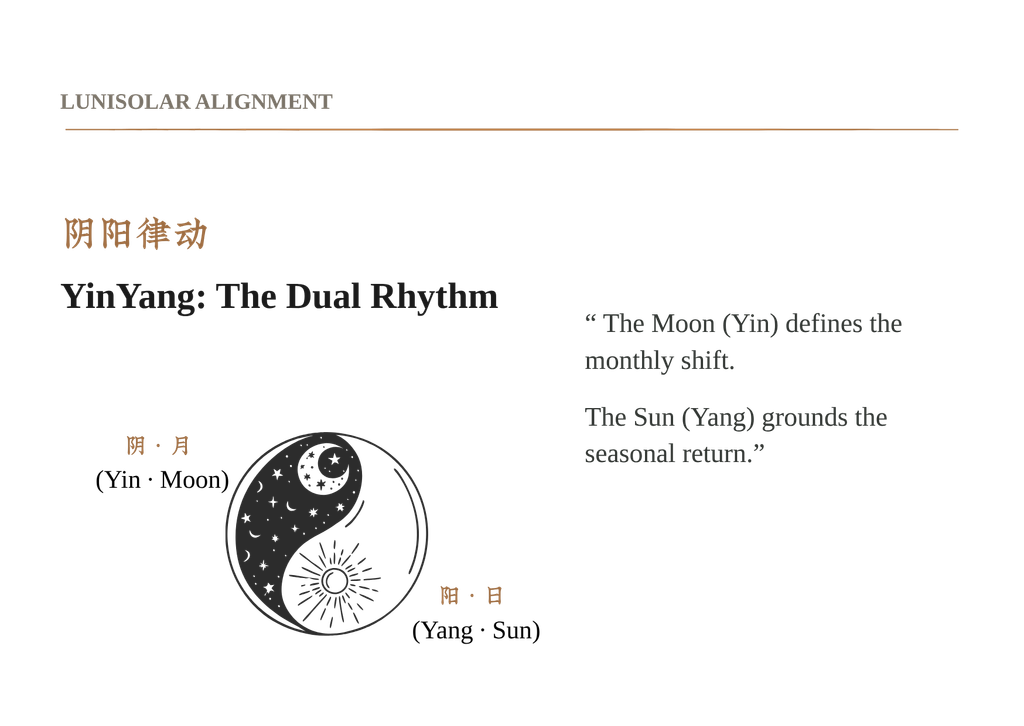
- The Traditional Chinese Calendar (Lunisolar): A hybrid system that harmonizes both celestial bodies. It uses the Moon to define the months(with leap month that typically appears every 2 to 3 years) and the Sun to anchor the year in the natural seasons.
This is why the date of Chinese New Year shifts on our “normal” calendars every winter: the festival follows a fixed lunisolar coordinate, which falls on a different Gregorian date each year (typically between January 21 and February 20).
In Chinese, this dual mechanics is reflected in everyday terminology:
- 阳历 (Yánglì) — Literally the “Solar Calendar” (the Gregorian calendar).
- 阴历 (Yīnlì) or 农历 (Nónglì) — Literally the “Lunar Calendar”, commonly used as a colloquial shorthand, or “Agricultural Calendar”, the official traditional lunisolar system.
In Chinese, this dual mechanics is reflected in everyday terminology:
How the Lunisolar System Actually Works
As said, LNY is safer-sounding phrase, but calling the traditional system simply a “lunar calendar” tells only half the story.
A calendar based purely on lunar months would cause spring festivals to slowly drift into autumn over a generation. To prevent this, the traditional Chinese system uses intercalation (Rùnyuè / 闰月)—inserting an extra leap month roughly every three years to keep the lunar months aligned with the solar cycle.
The Moon tells us where we sit within the month, while the Sun, tells us where we sit within the year.
The 24 Solar Terms: Reading the Ecological Year
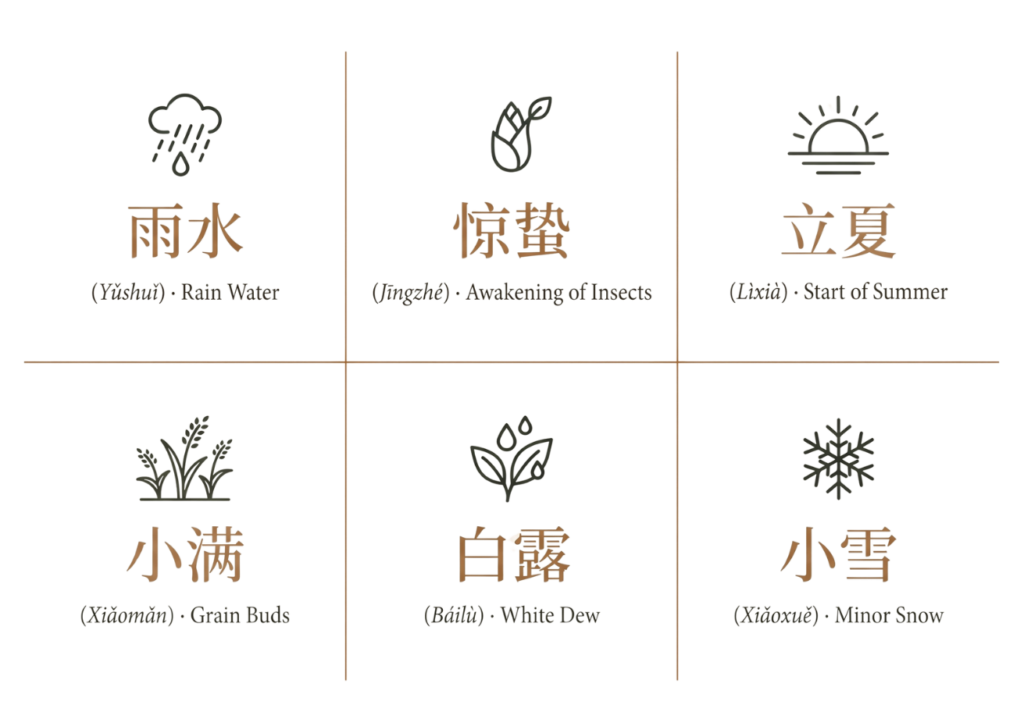
Embedded within this system is a second layer of seasonal knowledge: the 24 Solar Terms (二十四节气).
Recognized by UNESCO as an Intangible Cultural Heritage of Humanity, the Solar Terms divide the Sun’s annual orbital movement into 24 distinct 15-degree segments. Each point marks a specific ecological or meteorological shift, giving practical guidance to agricultural societies observing the natural world:
The traditional calendar was never just an instrument for counting days. It was a lived framework for reading the Moon, the Sun, and seasonal ecology in unison.
A Calendar for Living, Not Just Counting Days
As mentioned, the traditional calendar was named 农历 (Nónglì), literally, the “agricultural calendar”, for a reason. For an agrarian society, rather than being an abstract number on a screen, it was defined by practical survival: knowing when to prepare, when to sow, when to harvest, and when to let the fields rest. It reflected the kind of time people were living in instead of tracking dates.
From Agriculture to Modern Life
Today, few of us plow fields or track soil moisture. Our lives run on meeting invites, deadlines, flight times, and notifications. Time has become something we measure, schedule, and optimize for maximum productivity.
Yet our bodies still register the changing seasons, the subtle shift in daylight, the autumn crispness in the air, or the natural rise and fall of our energy throughout the year.
This is where the traditional way of thinking about time remains surprisingly modern. Instead of treating every day as an identical, productive unit that demands constant speed, the lunisolar rhythm offers a gentler idea: different phases of a cycle are meant for different things.
Knowing when to push forward is important—but so is knowing when to slow down, pause, and prepare for what comes next.
Explore the Traditional Chinese Calendar
Here, we’ve created a curated English calendar for the 24 Solar Terms (节气) and major traditional Chinese festivals. Unlike full lunisolar calendars, this feed focuses purely on key seasonal shifts, cultural rituals, and practical living guides to help you stay in sync with natural rhythms throughout the year.
You’ll also find notes on traditional rituals, seasonal customs, and simple practices you can try in your own daily life.
Follow the rhythm of the Moon, the Sun, and changing world, and perhaps find a rhythm of your own.